An Amateur's Guide to Quantum Physics
Aug 20, 2026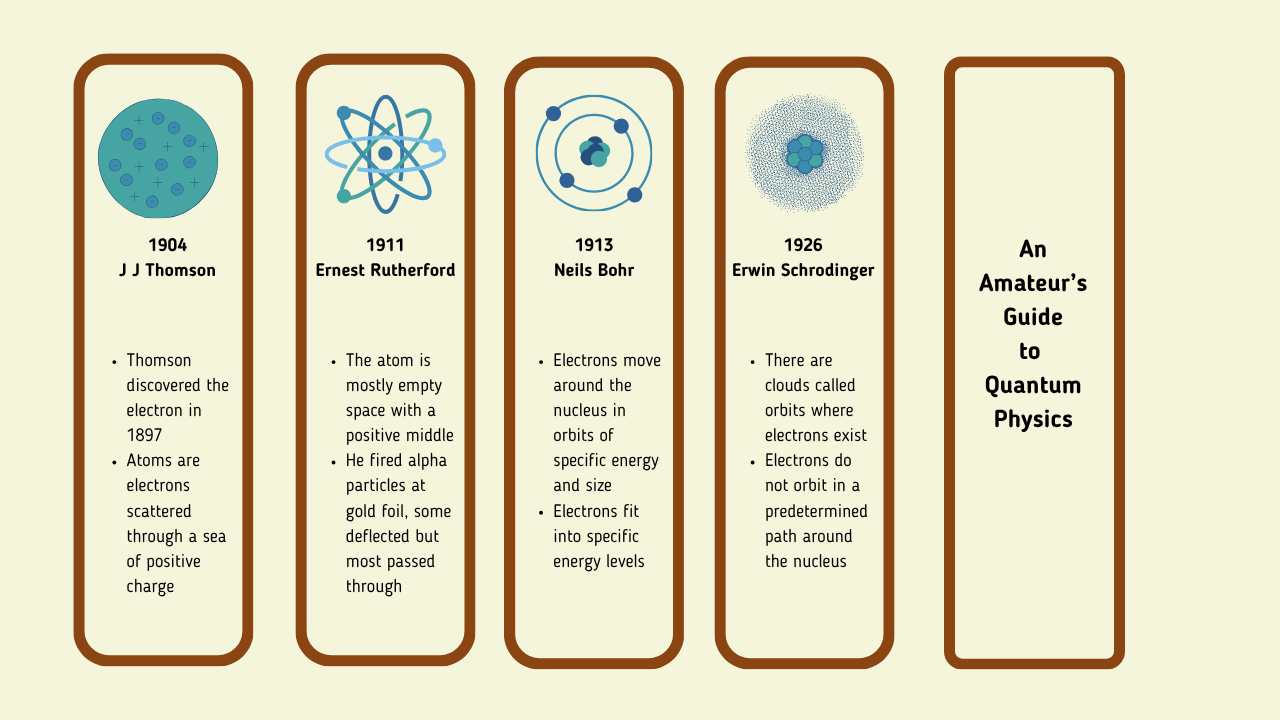
“If Quantum Mechanics hasn’t profoundly shocked you, you haven’t understood it yet.” Niels Bohr
NOTE: This is the original, full length version of the chapter that appears in the book Quantum Majic: Claim Your Power, Be Yourself, Manifest Your Purpose. It includes material that was edited out for length. The chapter title in the book is Appendix A-An Amateur’s Guide to Quantum Physics. I have included in here for those who may be interested in understanding more than was presented in that chapter about the principles and development of Quantum Physics over the last century.
___________
I certainly don’t fully understand quantum mechanics. Nonetheless, I spent about a year of self study to get a basic understanding of the concepts and issues surrounding Quantum Mechanics/Physics so that I could present this summary to you.
___________
Classical Physics studies the properties and behavior of “large” objects while Quantum Physics seeks to understand “small” objects. A large object doesn’t have to be the size of a star, a human being or a car. For example a cat, who will become very important in a certain thought experiment by Erwin Schrodinger, is also a large object. Small objects would include, for example, dust motes, atoms and electrons.
The classification of objects into large and small is a bit of a misnomer. Large objects appear to us to behave differently than small objects. However, they do have a core constituency of “small” atomic and sub-atomic particles. Therefore, one could think of large objects as both quantum and classical, even though their quantum effects are too minuscule to generally observe in everyday reality or to take into consideration in many scientific experiments.
Let’s briefly touch upon some basic concepts in Classical Physics that will be important to understand when we get to Quantum Physics. A central figure in the development of that field was, of course, Sir Issac Newton. He proposed three laws about the motion of objects and the force exerted upon them. These laws are universally famous. Many non-physicists will even occasionally quote them in response to a situation in their environment, without understanding their theoretical underpinnings. Newton’s Laws are one theoretical component that helps achieve the objective of Classical Physics, to describe the properties and behavior of large objects.
First is the law of inertia: “an object at rest tends to stay at rest and an object in motion tends to stay in motion.” The second law indicates how the acceleration of an object is determined by the force operating upon it. This law is important in establishing the position/location of an object and its velocity/ change in position over time. Newton’s second law in Classical Physics has a corollary in Quantum Physics to the Schrodinger Wave Function equation.
Newton’s Third Law is “for every action, there is an equal and opposite reaction.” This law illustrates the idea of cause (an action) and its effect (the reaction.) Cause and effect then raises the concept of determinism, which means that the things that happen now are a direct result of what came before them. The idea of a “Clockwork Universe” is often associated with Classical Physics and determinism is its foundation.
In this model, the behavior of a system can be predicted by knowing its origin and then applying the laws of physics that govern its behavior and changes during its lifetime. Newton’s lifetime was centered in the Age of Enlightenment. During this period, concepts such as the determinism of the Clockwork Universe were not just part of the Scientific Revolution. They were also crucial to discussions about human nature and philosophy, including the concept of free will.
Determinism would remain a central tenant of physics into the 1900’s. The emergence of Quantum Physics would begin to question and undermine this seemingly unshakable belief. Another tenant of Classical Physics that would be tested by Quantum Physics is that of locality.
In Classical Physics, locality means that an object is only effected by its immediate environment. This principle assumes that an interaction between an object and its environment can’t be instantaneous. When Einstein defines a constant for the speed of light in 1905, it gives more support for this assumption. However, the possibility of non-locality in Quantum Physics would become a major debate and subject of much experimentation in the 20th century.
Classical physics does a great job in describing the properties and behaviors of many things in our everyday reality. However, in the late 1800’s and early 1900’s, physicists tried to understand how such phenomena as radioactivity and the photoelectric effect worked. It seemed that the less “physical” something was, the less classical physics was able to properly describe it. A new model of physics was needed.
___________
What would eventually become Quantum Physics and, more specifically, Quantum Mechanics began with a number of different experiments. These were designed to understand, among other things, the existence and operation of atoms.
An atom is the smallest unit of matter. This word comes from the ancient Greeks. They thought an atom was indivisible, which will turn out not to be the case. Atoms are made up of a nucleus, containing neutrons and positively charged protons, surrounded by negatively charged electrons. Chemists accepted the idea of atoms in the 1800’s because their experiments with elements proved successful. Indeed, the first periodic table of elements and their atomic weights was published in 1869. However, it would take the physics community some time to fully accept atomic theory.
In the 1910’s, a physicist from New Zealand, Ernest Rutherford, created the initial modern description of an atom. It was later modified by the Danish physicist, Niels Bohr. You can think of the Rutherford model as the “cartoon” version of an atom. It has a large hard ball, the nucleus, in the center. It is surrounded by circular orbits containing small balls, electrons. This model can be seen as similar to the planets orbiting our Sun. However, Rutherford’s model had a problem. Its configuration of the electrons orbiting around the nucleus should make the atomic configuration unstable, which, of course, it is not. Atoms are the stuff of matter. If they were unstable, matter and, therefore, the universe as we know it could not exist.
Bohr’s modification resolved the issue of instability by giving the electron orbits fixed energy levels within which to operate. Bohr seemingly derived this idea from Max Planck’s concept that energy only comes in fixed packets known as “quanta.” It is Planck’s quanta that gives Quantum Physics its name. However, Bohr’s model had problems of its own. One of them was that it could only explain the behavior of the hydrogen atom, which has one electron. When you get to atoms with more electrons, Bohr’s model doesn’t accurately predict its behavior.
Only with the development, in 1925, of Erwin Schrodinger’s Wave Equation will we finally get a proper description of the atom and its electrons. Schrodinger’s atomic model is also known as the Electron Cloud Model. With it the image of a hard ball nucleus, surrounded by well defined orbits containing small balls of electron particles, was gone.
Instead, the picture literally becomes very fuzzy. The nucleus is no longer a solid, hard ball but rather neutrons loosely surrounded by protons. The electrons are no longer in sharply drawn orbits but rather in an “electron cloud, which is fuzzy and diffuse. The electrons are scattered within the cloud, some light and others dark. Their hard shape of little round balls is gone. Instead, electrons create an image that appears to be smeared, like that of a fuzzy photograph.
To more fully understand the difference between the Rutherford-Bohr atomic model vs. Schrödinger Electron Cloud Model, I would suggest an online search for pictures of each. Sometimes, a picture truly is worth a thousand words.
An accurate description of the atomic model was a significant accomplishment for the emerging field of Quantum Physics. Another challenge was the study of the nature of light.
___________
Human fascination with light and its nature goes back at least to the Ancient Greeks and probably before that. Its qualities were a subject of significant debate in 17th century physics. Christiaan Huygens, a Dutch mathematician and physicist of this period, thought light was a wave while Newton thought it was a particle.
It would be a long time before it was finally established that light could be either, depending on the circumstances. In 1801, British mathematician and physicist Thomas Young first performed what would become known as the double-slit experiment. When a beam of light was passed through the slits it formed an interference pattern on a screen behind them. This supported the idea that light was a wave, because waves can interfere with each other.
The debate would start to be settled in 1905. That was the year Albert Einstein would write what would become known as his Annus Mirabilis (miracle year) papers. His most famous equation E=mc2 formula comes from a paper that established the equivalence of mass and energy. A constant for the speed of light was established in his paper on Special Relativity. Another established mathematical evidence of a phenomenon known as “Brownian Motion” which is the movement of particles, in this case grains of pollen suspended in fluid. This action had been discovered almost a century earlier, in 1827, by the Scottish botanist Robert Brown.
Einstein’s final paper, on the Photoelectric Effect, won him the Nobel Prize. This theory provided support for the idea of light as a particle. Like Bohr regarding the atomic model, Einstein incorporated Planck’s quanta into his paper. Planck’s idea argued that energy, including light, comes in discrete packets. Several scientists would begin to use the word “photons” to describe light particles, but the name finally became popularized in the 1920’s by the American chemist Gilbert Lewis.
In 1923, American physicist Arthur Compton would perform an experiment that would verify Einstein’s assertion of light as a particle, for which he would receive a Nobel. It would become accepted that light could be either a wave or a particle, depending on the environment and conditions experienced. This would lead to a concept of the “wave-particle duality.”
___________
As I write this, in 2025, Quantum Physics is celebrating its 100th anniversary. 1925-1927 were defining years that saw the development of ideas that would become the basis of Quantum Mechanics. These would include the Schrödinger Wave Equation, Heisenberg’s Matrix Mechanics and his Uncertainty Principle.
Before we get to those, let’s return to the idea of wave-particle duality. Light was already determined to be able to act as either a wave or a particle. In 1924, French Physicist Louis Victor Pierre Raymond, the 7th Duc de Broglie, wrote his doctoral thesis. He is known as Louis de Broglie but I was amused by his title so decided to include it here. His paper outlined the de Broglie Equation, which proposed a “matter wave-particle duality” for particles in general and electrons in particular. It was a significant thought break-through in Quantum Mechanics, for which de Broglie received a Nobel.
Austrian Physicist Erwin Schrodinger piggybacked on the de Broglie’ Equation in the development of his Equation of Wave Mechanics, for which he also received a Nobel. As mentioned earlier, a core component of Classical Physics is measuring the position and velocity of a large object. A challenge in the early days of Quantum Physics was to find their equivalent values (known as position and momentum) for small objects. A solution would begin to be found in the Schrödinger equation. He used de Broglie’s duality premise to explain the wave behavior, over time, of a quantum system. For the sake of simplicity, one can think of wave behavior as “movement,” although that is not a technically correct definition.
Quantum particles, such as electrons, are “quantum objects.” Such an object is also known as a “quantum system.” Schrodinger’s Wave Equation calculates a “wave function” for a quantum system. A wave function is a mathematical representation of an object. The calculation assigns values (known as amplitudes) to points in space within the quantum system. Thus, the equation gives information about the wave behavior of a quantum system over a period of time.
Although it was a major break-through, the Schrodinger Wave Equation still belonged to the realm of Classical Physics. Max Born would take Schrodinger’s idea one step further and push it toward a quantum perspective. He performs a “collision experiment” with two particles. After the collision, the particles went off in different directions. Born concluded this action meant that the Schrodinger equation wasn’t describing a physical amplitude but rather a probabilistic one.
Having theorized that the amplitude values produced by the wave equation are probabilistic, he then developed the “Born Rule.” It uses the amplitudes that are output from the wave equation to calculate the probability of finding a quantum particle. This process produces a “Probability Density Function” of the possible measurement outcomes. The graph of this function is in the shape of a Bell Curve.
The use of probabilities turns out to be a critical component of Quantum Mechanics and it will be one reason why Born wins a Nobel. Probabilities will fundamentally change the way physicists see the nature of small objects and their behavior. Indeed, this change will trigger a decade long debate between different factions within the physics community, led by Bohr/Heisenberg on one side and Einstein/Schrodinger on the other. In a letter to Born, Einstein makes his famous assertion about God that “He does not play dice.”
Together, Schrodinger’s Equation and Wave Mechanics as well as Born’s Rule and Probability Density Function begin to form a working model of quantum theory. The use of probabilities in Quantum Mechanics will raise questions that will soon bring us to Heisenberg’s answer, in the form of the Uncertainty Principle, which will be discussed below. This will confirm the dawning understanding that Quantum Mechanics truly does not operate in the same way as Classical Physics.
___________
Finally, in our journey of the discoveries made in Quantum Physics from 1925-1927, we get to Heisenberg’s Uncertainty Principle. It is interesting to note that he initially called it the Principle of “Imprecision” or “Inexactness.” When he came up with this idea in 1927, Heisenberg was in Copenhagen. He was working as an assistant to Bohr and also as a lecturer at the university there. The Uncertainty Principle would become a crucial pillar in what would soon become the Copenhagen Interpretation of Quantum Mechanics.
The Heisenberg Uncertainty Principle says that the more you know (i.e. the more accuracy you have) about the position OR momentum of a particle at a given moment, the less accuracy you have about the other property. He argued that this dynamic indicates uncertainty is fundamental (i.e. inherent) to the way in which quantum systems operate. This fundamental nature is reflected in the measurement outcomes in Quantum Mechanics, which are stated as probabilities, rather than absolute values, about the state of the system’s wave function.
Heisenberg’s Uncertainty Principle also added a new feature into Quantum Mechanics, the “collapse” of the wave function. The Schrodinger Wave Equation assumes a “smooth continuous” change in the state of the wave function over time. However, this isn’t an accurate representation of wave function behavior when a measurement occurs. The process of measurement disturbs the state of the system being observed and collapses the wave function. Prior to measurement, there are probability amplitudes for all possible outcomes of where a quantum particle, such as an electron, might be located. When the wave function collapses, all of the probability amplitudes collapse into a single, definite outcome.
This dynamic created what comes to be known as the “measurement problem.” The first issue regarding this problem is to define who or what is the “observer” doing the measurement? A human being or a measurement device will be accepted as valid observers. However, who or what else qualifies as an observer? Einstein once asked: “When a mouse observes the universe, does that change the state of the universe?”
The second issue is why does the wave function collapse at all upon measurement? This is not a behavior seen in Classical Physics, where a measurement generally does not disturb the system being measured. It should be noted that the measurement problem is still an unanswered fundamental question in Quantum Mechanics. Although several theories have been proposed to address the problem, none have yet been validated.
It should also be noted that Heisenberg’s calculation left a question about the amount of uncertainty caused by the fundamental nature of a quantum system versus that contributed by any disturbance during the measurement process. Recently, this been addressed by a new calculation which accounts for both factors. It was developed by a Japanese physics professor named Masanao Ozawa and is called the Measurement Disturbance Relationship.
___________
Heisenberg’s arguments were not readily accepted at first, which is not surprising. The Uncertainty Principle deals a blow to the classical Clockwork Universe, with its fundamental tenet of determinism. If you can’t measure properties such as position and momentum with complete accuracy, where does that leave one in terms of making sense of the quantum world?
The emerging model of Quantum Mechanics was proving to be very strange indeed. It encompassed concepts such as wave-particle duality, measurement results expressed as probabilities and the Heisenberg’s Uncertainty Principle. During the first half of 20th century, the great minds of physics began looking for an appropriate “interpretation” of quantum theory.
This effort was an attempt to understand the underlying reality of the quantum world and how it connects to our experience of everyday reality. The term interpretation is a misnomer because what is really been sought is a foundational theory of how Quantum Physics works. However, “interpretation” is the commonly used word for this process.
So, a lot of thought and discussion was given in the late 1920’s to developing what was essentially a “philosophy” for Quantum Physics. Philosophical discussions were prominent in Europe at this time. A group known as The Vienna School developed what would become the widespread philosophical system of “Logical Positivism” during this period. A simplified view of it is that only what can be observed should be accepted as real and therefore be subject to experimentation. Under that definition, the microscopic quantum world would not be real and could not be tested. Logical Positivism would turn out to be both a blessing and a curse to the discussions around Quantum Mechanics.
A prime example of this search for a greater understanding was the Fifth Solvay Conference in 1927. The topic for that year was Quantum Mechanics. More specifically, it was a discussion of two quantum particles, electrons and photons. Bohr and Heisenberg would make presentations that would hint at what would later become the “Copenhagen Interpretation.” which is discussed below. Bohr and Einstein would begin debates about the accuracy and “completeness” of Quantum Mechanics that would continue into the 1930’s
The early physics community found it unsettling that Quantum Mechanics didn’t describe the world as neatly as the determinism of Classical Physics. Unfortunately, after the early years and development of the Copenhagen Interpretation this effort would go dormant. Subsequent generations of physicists would abandon, for several decades, any significant attempts to find a foundational interpretation.
Most of the physics community, even today, doesn’t appear to worry about a foundational explanation or interpretation of the strangeness of quantum mechanics. The formulas work in “real world” applications, so let’s just use them and move on.
While there is a small coterie of “Foundational Physicists” today who study such things as interpretation, they make up only a tiny percentage of the physics community. For the vast majority of physicists, who work in academia, government facilities or the private sector, the motto appears to be “shut up and calculate.” This phrase was coined by either N. David Merrin or Richard Feynman. The attribution seems to be in dispute, although most argue for Merrin as the source.
__________
Having talked about why the early physics community felt the need for an interpretation or foundational explanation of Quantum Mechanics, it is now time to introduce the most prominent one. This is the Copenhagen Interpretation, which is often referred to just as “Copenhagen.” Physicist Niels Bohr had an institute for the study of physics in that city and some of the early discussions were held there. This is why the interpretation is named after the Danish city.
Bohr was the primary driving force behind Copenhagen. His forte was developing philosophical foundational principles, rather than formulating rigorous mathematical representations of Quantum Mechanics. His writings and verbal presentations were often criticized as being ambiguous. Bohr’s lack of definitive meaning seemed to have both contributed to the amorphous quality of Copenhagen itself and to his successful popularization of it.
Its hard to believe now that such a slight of hand was successful. However, alternative interpretations weren’t initially available and the ones that came later were initially judged as even more incredulous than Copenhagen. Between Bohr’s efforts and the lack of a strong competitor, it quickly became the most accepted interpretation, seemingly by default.
It should also be noted that Bohr and the Copenhagen Interpretation got some help from a book that was published in the 1930’s by the Hungarian mathematician and physicist John von Neumann. It contained an argument that theoretically ruled out hidden variables in Quantum Mechanics. This “proof” was highly touted in the physics community to support Bohr and Copenhagen as well as to to defuse Einstein’s disagreement with Copenhagen. However, Scottish physicist John Stewart Bell and others would later find a flaw in von Neumann’s proof.
Bohr seemed to have been a charismatic character. Also, unlike Einstein, he was proactive in accumulating acolytes. A number of them had been his students or assistants, who would later support their mentor’s Copenhagen Interpretation. These students would also become university professors, who would then teach a fair percentage of the next generation of students to believe in Copenhagen. This would continue down through the line of physics students.
As you read about Copenhagen below, don’t be surprised if you feel that it doesn’t present a coherent picture and a clear explanation of how Quantum Mechanics works. As hinted at above, you won’t be the first person to feel that way. Indeed, some physicists will develop alternate interpretations because they also questioned Copenhagen. I will outline a few of those later.
Copenhagen cobbles together a bunch of ideas that were present in the physics community from 1925 into the 1930’s and then adds a few more. I’m going to try to assemble those ideas here in as coherent a way as I can. However, it is important to recognize that there isn’t one strict definition of the Copenhagen Interpretation. Indeed, in the decades since Bohr and his supporters developed it, many physicists have disagreed over the principles and which ones should be included in the interpretation. Understand that my interest is in laying out the ideas from Copenhagen that I consider will be important later in an understanding of Quantum Majic.
To start, remember that the reason for developing a foundational interpretation of Quantum Mechanics is to understand the underlying “reality” of quantum systems and how that reality intersects with our everyday, physical reality. Interestingly, Bohr and his supporters argued in the Copenhagen Interpretation that there is no underlying quantum “reality” or quantum “world.” Before observation and measurement, a quantum system is just a field of potential, in a state of probabilistic outcomes. It does not exist until we observe and measure it.
While the quantum system isn’t “real” in the Copenhagen Interpretation until measurement occurs, its probabilistic state can be mathematically represented by the wave function. Quantum objects have a wave-particle duality. Prior to measurement, possible outcomes of where an object, such as an electron, is located are expressed as amplitude probabilities. The calculation of probabilities reflects the fundamental nature of quantum systems/objects, in that they contain some inherent uncertainty. The measurement process disturbs the quantum object and causes the wave function to collapse into a definite state.
You will note that we have encountered all of these ideas earlier. However, the Copenhagen Interpretation is going to add some new concepts, as outlined below:
In developing his “Complementarity Principle,” Bohr took Heisenberg’s arguments about the accuracy of measurement one step further. He proclaimed that you could only measure position or momentum in a given experiment. If you chose to measure position, you would have no information about momentum and vice-versa. Indeed, you needed experiments about both properties to fully map a quantum system.
It seemed that the two principles went together. Heisenberg’s argument that you couldn’t have full accuracy about both properties might justify Bohr’s measurement restriction in the Complementarity Principle. In turn, Bohr’s Complementarity might provide an explanation for the fundamental uncertainty exhibited when measuring both properties simultaneously, as formulated by Heisenberg.
As mentioned earlier, the Copenhagen Interpretation states that there is no quantum “reality” or “world” prior to measurement. It is the observer and the process of measurement that collapses the wave function and produces a single, definite outcome from the probabilistic state. The observer can be a human being. However, it can also be, and often is, a mechanical or electronic device. This is true because the observer does not need to have “consciousness” in order to perform the measurement and thereby collapse the wave function.
Finally, the Copenhagen Interpretation explicitly states the “Completeness” of Quantum Mechanics. In part, this means there is no need for “hidden variables,” which will be introduced later in the section on Pilot Wave Theory. Perhaps Bohr felt he needed to assert this idea in answer to Einstein’s complaints about the theory of Quantum Mechanics, which we will get to in a minute. However, just stating something doesn’t prove it. It would take physicists other than Bohr to provide evidence for and against the theory’s completeness.
The Copenhagen Interpretation was given strength from earlier concepts developed by Louis de Broglie, Erwin Schrodinger, Max Born and Werner Heisenberg. However, it also incorporated one major weakness, the measurement problem. Over the intervening decades, this weakness would leave the door open for development of new interpretations. Other factors, such as the bizarre implication of the Schrodinger Cat thought experiment, which is discussed below, would add to the unease about Copenhagen, despite its growing acceptance.
Nevertheless, if you asked a group of physicists today which interpretation they preferred, the majority would probably still say Copenhagen. This is partly because that is what they were taught in college as the “accepted” standard. So why choose anything else, especially since most don’t particularly care about interpretations? I think perhaps another reason is that the other interpretations are just “a bridge too far” for them. Perhaps they have just convinced themselves that Copenhagen, measured on a “continuum of strangeness,” is simply the least strange of the bunch!
___________
Before outlining some of the other interpretations, two arguments from the early debates in Quantum Mechanics need to be presented. These are the Schrödinger’s Cat thought experiment and the EPR (Einstein/Podolsky/Rosen) paper, both of which were published in 1935.
In order to discuss Schrödinger’s Cat, a new concept needs to be introduced. This is the idea of “super-position.” You will recall that Born utilized the wave amplitudes calculated in the Schrodinger Wave Equation to produce the Probability Density Function. Every possible outcome is included in this picture, each with a probability amplitude.
Let’s say a particular quantum system has two probability amplitudes or possible outcomes for the location of an electron. Until the wave function is collapsed, the quantum system to be measured exists simultaneously in both states. It is in location 1 and location 2 at the same time. How can an electron exist in both possible outcomes simultaneously? This is the dilemma is known as super-position.
Super-position may seem strange but acceptable when you are dealing with a microscopic quantum object, like an electron. However, Schrodinger’s Cat will illustrate the dilemma when applied to larger objects. Below is a description of the experiment. I apologize to any cat lovers out there about the gruesome nature of the details. As a cat lover myself, I cringe every time I think of the poor cat and have to remind myself this is a thought experiment, not an actual laboratory test.
So, into a box you place a mildly radioactive substance, a Geiger counter, a small hammer and a vial of cyanide. You then add in a cat and close the box. You wait a length of time that represents a half-life, which is a 50% probability in this case, that the substance will emit a radioactive particle. If it does emit the particle, the Geiger counter will detect it. This will release a suspended hammer, which breaks open the vial. The release of the cyanide kills the poor kitty. If the radioactive substance does not emit a particle, none of this happens and the cat remains alive.
Seems simple enough, right? When you open the box, the cat is either dead or alive. However, you need to remember the Copenhagen Interpretation says that a quantum system does not exist until measurement by an observer. In this case, the observer would be a human being opening the box.
In formulating his thought experiment, Schrodinger was pointing out what he saw as a flaw in the Copenhagen Interpretation. He argued that the theory incorrectly says that, until the box is opened, the cat is in a super-position of being both dead and alive, with a 50% probability of either. No living creature can be simultaneously dead and alive. Not even wily cats, who are known to have nine lives.
You could also argue that the cat doesn’t count as a valid experiment subject, because it isn’t a “small” quantum object. Therefore, how can it be in super-position in the same way as an electron? A possible answer may be found in The Many Worlds Interpretation that I will introduce later.
___________
Another challenge to the Copenhagen Interpretation would be the 1935 EPR paper. Starting at the Solvay Conference in 1927 and continuing into 1930’s, Einstein would make the following argument: The theory of Quantum Mechanics, as expressed in the Copenhagen Interpretation, is either incomplete OR the principle of locality, as assumed by Classical Physics, is not valid on the quantum level.
Before getting to the paper’s specific arguments, it would be helpful to introduce a new concept, “entanglement.” If two or more particles become intrinsically linked, they are considered entangled. No matter how far apart these particles are, when a measurement is made on one of the entangled particles, it impacts the outcome for the other particle. Below is an example of how entanglement works.
Electrons can be measured for the property of “spin,” along a vertical or horizontal axis. An experiment can be created with two entangled particles that, depending on the spin of the first particle, will predict the spin of a second particle. Let’s say the experiment is formulated such that, if the first particle is “spin up,” the second particle would be “spin down.” This will be the outcome, no matter how far apart the particles are located.
Einstein called this dynamic of entangled particles “spooky action at a distance.” He argued against the “non-locality” that would be required for entanglement to work. Einstein thought the second particle would need instantaneous information about the state of the first particle and the speed of light constant prohibited this.
With this understanding of entanglement, let’s move on to the arguments in EPR. At first glance, it would appear that the idea of completeness and locality being mutually exclusive was straight forward. However, as I will outline below, it was not.
You will recall from the beginning of this chapter that, in Classical Physics, locality means that an object is only effected by its immediate environment. Further, after Einstein’s 1905 Special Relativity theory established the speed of light constant, the principle of locality also assumed that an interaction between an object and its environment couldn’t be instantaneous. Using the speed of light restriction, EPR argues that “non-locality” isn’t possible. This would mean that entangled particles could not communicate information instantaneously over a long distance.
Therefore, even though EPR initially states its’ argument as either locality is invalid on the quantum level OR Quantum Mechanics is incomplete, the paper’s authors then go on to argue that locality must be valid on the quantum level. If this is true it would, therefore, mean that quantum mechanics must be incomplete.
Understanding EPR argument can be confusing unless you understand that Einstein didn’t believe in one of the very arguments (i.e. that locality could be invalid on the quantum level) that EPR had proposed as a valid possible answer! Given that, the answer must be that Quantum Mechanics is incomplete. If that were true, it would also invalidate the Copenhagen Interpretation, which makes an assumption of completeness. This would get Einstein to the answer he wanted all along.
What does it mean to say that EPR argued that Quantum Mechanics is incomplete? “Completeness” in this case refers to the amount of information you must have about a quantum system. Now we bring back in the idea of entangled particles. Einstein argued that you must know the definitive value of the properties of both the entangled particles, even without measurement, in order to have completeness. He also suggested that hidden variables might exist which could make Quantum Mechanics complete. Einstein had been making these arguments since 1927 at Solvay. However, along with Podolsky and Rosen, he formalized them in the 1935 EPR paper.
Complementarity was Bohr’s answer to the arguments in EPR. You will recall that complementarity says you can’t measure both position and momentum in the same experiment. Bohr argued EPR’s requirement that entangled particles must have a value for both properties simultaneously was incorrect. Therefore, Bohr stated, the arguments in EPR did not prove that Quantum Mechanics fails the completeness test.
Ultimately, Einstein would be proved wrong but not because of Bohr’s complementarity argument. Rather it would be by centering EPR on the argument that locality is still valid when you move from the classical to the quantum level.
In 1964, almost 30 years after EPR was published, the Irish physicist John Stewart Bell would successfully propose the opposite. Non-locality is indeed valid on the quantum level. “Bell’s Theorem” would then later be proven in experiments conducted by the French physicist Alain Aspect. Thus, Bohr’s legacy of Copenhagen as the dominant interpretation would continue but not because of his counter argument to EPR regarding complementarity.
So, if non-locality is valid, why doesn’t it violate the speed of light restriction, as Einstein argued? Physicists today propose that information is not really transferred at all between the entangled particles. Rather, they argue that two or more entangled particles form a single quantum object, even over a long distance. They can act in concert, without needing what we would consider communication in order to do so.
Like Schrödinger and his cat thought experiment, EPR was intended to cast doubt on the Copenhagen Interpretation of Quantum Mechanics. In the end, though, super-position, non-locality and entangled particles would all be determined to be valid. Combine these concepts with wave-particle duality, outcome results measured as probabilities and the fundamental nature of quantum systems having an element of uncertainty. Taking these ideas all together, it is no wonder that Quantum Mechanics is considered very strange, no matter how well its formulas calculate useful results.
___________
We have spent a lot of time outlining Copenhagen and the debate surrounding it. It’s now time to turn to several other “interpretations” of Quantum Mechanics. These theories were developed to address what was seen as flaws in the Copenhagen Interpretation, which included the measurement problem and the generally ambiguous nature of Copenhagen.
In 1952, American physicist David Bohm publishes his Pilot Wave Theory. To help explain it, we need to go all the way back to de Broglie’s Wave-Particle Duality. Indeed, the theory is often referred to as the de Broglie-Bohm Pilot Wave Theory. This is because de Broglie had first posed it 25 years earlier. However, he got such a bad reception after presenting it at the Fifth Solvay Conference in 1927 that he abandoned it. Bohm would rediscover and complete it.
Bohm assumes that the “pilot wave” function can “guide” entangled particles over a long distance. It also assumes that particles have a definite position and momentum prior to measurement. Although the theory isn’t strictly classical, because of its use of entanglement and non-locality, it does have a deterministic element in its approach.
Bohm’s theory rejects several of the Copenhagen principles: that there is no quantum “reality” prior to measurement, that the quantum object exists in a probabilistic state prior to measurement, that an observer is needed for measurement and that it is the act of measurement that forces the quantum system into a definitive state. Further, there are no super-position states of the wave function and the wave function does not collapse upon measurement.
The result of all of this is that the measurement problem, so bothersome with Copenhagen, goes away! You don’t have to worry about who or what constitutes an observer or what constitutes a measurement. You also don’t have to question why measurement collapses the wave function.
However, it should also be noted that non-locality, which Einstein had rejected, was assumed in the Pilot-Wave theory. Finally, Bohm should be credited with developing what would become the idea of “decoherence” in Quantum Mechanics. That concept will be defined in the next section.
While Bohm’s theory had a lot of appealing qualities, as outlined above, it did not gain general acceptance for two reasons. First, it assumes the use of hidden variables. These are used, for example, to determine the initial position of the first particle. Hidden variables aren’t popular in physics. Second, the theory needs two equations in order to explain the pilot wave function’s process of guiding the entangled particles. This makes the math involved complicated and cumbersome.
Nonetheless, Bohm’s theory did present a significant new alternative for thinking about Quantum Mechanics. Some physicists today are trying to resurrect it, perhaps because it seems more definitive than the eccentric nature of Copenhagen.
David Bohm had one more contribution to add to the understanding of Quantum Mechanics and what it reveals about the underlying nature of reality. In the 1970’s, he developed a theory that the Universe has a level of unity where everything is connected. It also has holographic properties, where a small part of the whole contains the entire image of the whole. He called this whole of the Universe the “implicate” order. Implicate means that all things in the Universe are “enfolded” together, reflecting the holographic properties. The physical plane, what is sometimes called “the real world,” is the “explicate” order. Explicate means that there has been an “unfolding” of part of the implicate order on to the physical plane.
___________
In 1956, another American physicist, Hugh Everett III, drafts his PhD thesis at Princeton. When he presented it to his adviser, John Wheeler, the draft was titled “Wave Mechanics Without Probability.” Remember that title because the idea of “without probability” is key to understanding what will become the Many Worlds Interpretation.
The final title of his 1957 doctoral thesis was “The Theory of the Universal Wave Function.” Everett made a number of fundamental changes that were requested by Wheeler. The final paper kept the mathematics of the Universal Wave Function. Removed, however, were the conceptual underpinnings of Everett’s original draft. One of these was the argument about not needing to assign probabilities to potential outcomes. The other argument was the potential for many worlds to exist simultaneously.
Having received his doctoral degree, Everett did not stay in the academic world and defend his ideas. Instead, he went to work for the DOD and later founded his own company, making money on innovations to various mathematical algorithms.
Thus, Everett’s theory would languish for 20 years. Then, in 1977, Wheeler would invite Everett to give a talk about it at The University of Texas. This presentation would help resurrect Everett’s theory in the physics community. In addition, a technical journal would subsequently publish Everett’s original thesis draft, including the conceptual arguments that had been removed. A student of Wheeler’s, Bryce Dewitt, would become a fan of Everett’s work. He would later promote the theory and be the one to dub it The Many Worlds Interpretation. The name stuck.
Since the 1970’s, there has been a lot of discussion about the MWI (Many Worlds Interpretation), although by no means has it become widely accepted by the physics community. In addition to the efforts of Dewitt to highlight the MWI, I think there are a couple of other reasons for a renewed interest in the theory. In the decades since the death of Niels Bohr and his fellow proponents, their significant pressure on physicists not to criticize Copenhagen has been removed. Also, members of the physics community, such as Fritjof Capra, began to write unorthodox books like The Tao of Physics. This started to give physicists permission to explore less conventional ideas.
So, what does the MWI say and how does it work? It makes the following assumptions:
1. The Schrödinger equation is valid at all times.
2. The wave function is “physically real” and not just a mathematical representation.
3. The observer is part of the quantum system being measured.
4. The wave function does not collapse upon measurement. Instead, it splits or “branches.” The individual branches represent each of the possible outcomes. These branches exists in new “worlds.” When measurement happens, we can only see the world that we end up in. The other possible outcomes also manifest but are not accessible by us, because they are in alternate worlds.
5. There is one Universal Wave Function for all quantum systems, not individual wave functions for them.
You will recall that Bohm’s Pilot Wave Theory rejected some of the Copenhagen principles. Everett’s theory goes much further and throws out the Copenhagen Interpretation entirely. What are some implications if the MWI is the correct interpretation of Quantum Mechanics?
The probabilistic state concept goes away because all possible outcomes manifest upon measurement, not just one. So you don’t need to assign probability amplitudes to each potential outcome.
Since all possible outcomes manifest somewhere, MWI also solves the dilemma outlined earlier regarding Schrödinger’s cat being simultaneously dead and alive. The cat is truly alive in one branch and truly dead in the other before any measurement is made by an observer.
MWI also eliminates the measurement problem, because the observer is now part of the quantum system being measured and the wave function no longer collapses.
Eliminating the use of probabilities also moves the classical and quantum views of reality closer together. Like Schrodinger’s Wave Equation, the MWI can be considered classical.
Also, because everything is part of the Universal Wave Function, then locality is again valid and the action of entangled particles is no longer “spooky action at a distance.”
The MWI requires a radical shift in one’s thought processes, which draws some strong criticism as a result. Here is a brief outline of some of them:
1. The MWI can’t ever be “proved” to be true or false, because we don’t have a window to see into the other outcomes. Therefore we can’t ultimately prove that the other worlds do, in fact, exist.
2. Some theoretically “possible” outcomes might not actually be possible. For example, there might be a possibility one could envision but it violates the laws of physics, at least in our world. However, that criticism begs the question, would all worlds operate under the same laws? Perhaps there is a world where the laws of physics are different than ours, such that the outcome that is not possible in this reality would be possible there?
3. If the wave function is the entire Universe, who or what acts as its observer? That notion bends my brain as much as when The Oracle asked Neo if he would have broken the vase if she hadn’t said anything about it? If the observer is part of the quantum system being measured, as assumed under MWI and, if that system is the Universe itself, how does that work?
4. Without probability, can you predict which outcome will manifest in your world and how would you go about doing so? A related question is why then does the probabilistic method of measuring quantum systems work so well in “real world” applications? Everett had tried, without success, to reformulate the Born Rule within the MWI and this remains an open question.
Everett also did not address the question of why we can’t see the alternate worlds created by the other outcomes. An answer may lie in the concept of “decoherence.” As mentioned earlier, Bohm proposed this idea in his Pilot-Wave Theory. He argued that decoherence might have an impact on the process of the pilot-wave function guiding the entangled particles.
Decoherence happens when a quantum system interacts with its environment. Information about the quantum system “leaks” into the environment, causing it to begin to lose its coherence. This decoherence is characterized by the break down of entanglement between objects. Also, the quantum system is no longer able to be in a state of super-position of possible outcomes. These changes result in the system acting as classical, rather than quantum. A lot of work has been done since the 1970’s to better understand decoherence in Quantum Mechanics.
Regarding the MWI, the speculation about decoherence is as follows: After branching, each new world begins to interact with its environment. This interaction triggers decoherence of the entanglement that had existed between the various outcomes prior to the branching process. Because of this decoherence, the individual worlds become separated and can’t see or interact with each other.
Finally, it should be noted that the MWI of Quantum Mechanics is not the same as the concept of the Multiverse. That idea belongs to the field of Cosmology. It is speculated that a Multiverse might have been created as part of the Big Bang that includes our Universe.
Despite the significant criticisms of the MWI, it is very appealing in its possibilities. These include the idea that a person could simultaneously experience multiple lives in alternate worlds.
___________
Before ending the discussion of interpretations, here is a brief mention of two other theories. Objective Collapse Theory states that collapse of the wave function is not because of measurement. Rather, it is a fundamental component of Quantum Mechanics and happens on what seems like a random basis. Recent experiments seem to indicate that this theory may work on the level of small objects but not work for large objects. I would ask if something that appears random is in fact so? Perhaps the randomness is indicative of something that we just don’t understand yet? This would be similar to the 90% of “junk DNA” for which we have yet to identify its purpose.
Quantum Information Theory shifts the focus completely away from developing theories of the properties of particles, like position and momentum. Instead, it is argued that one should consider information, not particles, as the fundamental component of Quantum Mechanics. The criticism of this theory is centered in the argument that information is not fundamental. Information, critics of the theory would argue, is simply an output of the measurement process.
As you can see, there is a wide ranging variety of ideas about how Quantum Mechanics works and what it says about reality. Since the physics community has yet to definitively prove an interpretation for Quantum Mechanics, it will be interesting to see how the process evolves and how the existing theories may or may not be incorporated.
___________
As I observed before, it seems that most physicists don’t want to be bothered with foundational questions. Quantum mechanics works for a myriad of applications, so just “shut up and calculate.” However there are real world problems that the Quantum Physics framework hasn’t solved.
One major example is quantum computers, where a high rate of errors are limiting their effectiveness. Errors in quantum computing stem primarily from decoherence, where the computer can’t be sufficiently isolated from its environment and the interaction impacts its’ operational accuracy. One “work around” technique is the use of super-cold environments. High temperatures create a thermal vibration or “noise” that triggers decoherence in quantum computers.
Rather than making a greater effort to identify and solve the underlying issue, physicists instead seem to try to speed up getting to their objective by “just treating the symptoms of the problem.” This statement may sound to you a lot like the way that conventional medicine treats patients. The comparison of the two was intentional on my part.
As a non-expert, my question is: Could a proper foundational explanation of Quantum Physics help solve such problems? Wouldn’t you be better able to formulate experiments and real world outcomes, like quantum computers, if you more fully understood how the quantum world really works? I know this idea probably sounds like a pipe dream to physicists but I can’t help but think that more effort in this regard could yield massive benefits.
___________
Before I wrap up this chapter, I would like to say that I have done my best to accurately present information in this primer. If anyone out there, with more in-depth knowledge, sees something I have incorrectly described, I would appreciate being informed, via the contact information provided on the title page.
I would ask that you please be polite in your response. Any mistake I might have made is unintentional. I would appreciate it if you would not use it as a cudgel, especially if your viewpoint on the topics of this book disagrees with mine. As I have indicated elsewhere, we are all meant to have our own individual experience of the world. I honor your unique journey and would ask that you do the same for me.
___________
As I indicated when this chapter started, I will take some of the Quantum Mechanics concepts I have outlined here and apply them to Quantum Majic. This might upset many physicists, those who hate it when they think their principles are being incorrectly applied to “woo woo” activities. To which I reply: The physics community doesn’t “own” information on how the Universe works. It belongs to all of us. Further, if Quantum Physics concepts work within the framework of Quantum Majic, then how can you argue against incorporating them?
___________
As much as I tried to simplify it, I know this was a long and complicated introduction to Quantum Physics. However, was it very important to present because the various concepts outlined here are going to be incorporated into the model of Quantum Majic. These include observation and measurement, collapse of wave function, entanglement, super-position and decoherence. Understanding how these principles work in Quantum Physics will, I hope, make it easier for you to grok the principles of Quantum Majic.
Join to receive the Quantum Wizard Journal weekly blog posts.